CD&T Vaccines
Late each winter, about thirty days before our does and ewes begin giving birth, our team breaks out the hoof trimmers, needles, syringes, and vaccinations to get our herd and flock prepared for a successful, healthy spring of kidding, lambing, and returning everyone to pastures. Part of everyone’s work-up includes an annual booster shot of the CD/T vaccine, which helps the animals build immunity to the bacteria Clostridium perfringens types C and D and Clostridium tetani. These scientific names might sound vaguely familiar to you—some types of C. perfringens can cause food poisoning and C. tetani bacteria lead to tetanus
***
What are Clostridium bacteria, and why are they dangerous to goats and sheep?
Clostridium bacteria can be found almost everywhere, living in the soil and the intestines of many animals (including humans!). Under the right conditions, the bacteria reproduce quickly and can produce toxins that cause serious infection. Both C. perfringes types C and D can lead to enterotoxemia in sheep and goats. Enterotoxemia from type C occurs when a young lamb or kid is drinking too much milk, giving the bacteria the right food and conditions to grow quickly in the small intestine of the animal. Type D enterotoxemia, on the other hand, tends to impact lambs who are eating a diet high in grain or, occasionally, too-rich pasture. The type D bacteria thrive on the high energy of these diets, reproducing quickly and producing a usually-fatal epsilon toxin. The final clostridial disease that most often impacts goats and sheep is tetanus, which is the result of a neurotoxin produced by C. tetani. Because C. tetani is everywhere in the soil, it can easily find its way into wounds on goats and sheep. Young animals are especially vulnerable because they are often being disbudded, castrated, and tattooed in the first several weeks of their life and have undeveloped immune systems, but adult animals are also at risk as they forage through brambles in the woods, get stuck in fences, come into contact with poopy bedding during birth, or otherwise sustain an injury. Clostridial diseases like enterotoxemia and tetanus are virtually untreatable. Often, once an animal is experiencing symptoms of either disease, it’s too late to save them.
Why do we vaccinate the moms instead of vaccinating the babies when they’re born?
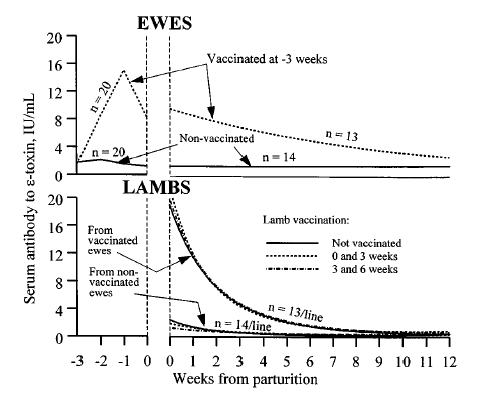
Like much of the kids’ and lambs’ immune-building process, the babies show the greatest amount of immune response to vaccination when they absorb those antibodies passively through their mom’s colostrum—the thick, yellowy milk that they drink in the first 1–3 days of their life. In fact, a study done by Christina de la Rosa, Doug Hogue and Michael Thonney at Cornell University in 1997 showed that lambs born to non-vaccinated ewes showed little to no development of antibodies, even when the lambs were vaccinated in the first 0–3 or 3–5 weeks of life. On the other hand, lambs born to vaccinated ewes developed many, many more antibodies regardless of whether they were vaccinated themselves.
All of the babies on our farm will eventually receive their own set of CD/T vaccines: once at 12 weeks, when their initial immunity has waned, and a second dose 3-6 weeks later to develop the full immune response. Then, every animal gets a booster shot each year to maintain their immunity.
Dang, that’s a lot of shots! Is there anything else you can do to prevent these diseases?
Totally! Like any of our animal management on the farm, we take a multi-pronged approach that includes medical tools, like vaccines, and management tools, like a carefully managed feeding program. Our sheep are grass-fed and raised only on pasture, so they are at much less risk for infection from C. perfringes. When we introduce our kids to grain, we do it slowly under monitored conditions to make sure no one is eating too much. While we don’t disbud our animals, we make sure that any animals we castrate and tattoo are at peak immunity before doing these procedures (either in the first week or two after birth in the case of tattoos, and 18 weeks after birth in the case of castration). Combining multiple methods in our management results in the most successful prevention results.
***
As of this week, all of our goat herd have received their CD/T boosters, hoof trims, and other pre-kidding work-ups, and we’ll be wrapping up the sheep next week, which can only mean one thing: kidding and lambing begins in three weeks! Thanks for letting me nerd out with you, and next time you hear from me, I’ll be bringing the scoop on all things kidding.

This month’s Lab Notes is also brought to you by my co-authors Isis, Maia, Gaia, and Gigi, who all contributed face rubs, laptop bonks, and finger nibbles to the writing process.[insert photos from Tig here]